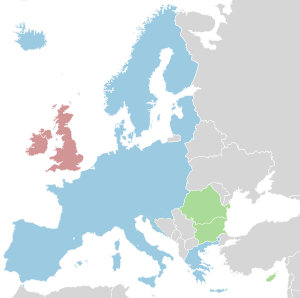
Schengen Agreement (Photo credit: Wikipedia)
Riyadh: Saturday 19th January 2013
No one who has followed American politics for the last 18 months can be in any doubt that President Obama cuts a slightly divisive figure with some on the political right.
And no one who has followed British politics over the last 18 months can be in any doubt that a Renascence of anti-European political discourse has been sweeping the nation, especially on the political right.
I must be careful to avoid generalization of course. Euroscepticism is not confined to the Right of British Politics (or even to British Politics, generally) and a suspicion that Obama lacks the ability to the political build bridges and consensus required to tackle America’s pressing problems is not confined exclusively to Republicans. Yet, in intervening to publish a transcript of a telephone conversation between the President and UK Prime Minister, David Cameron, Obama has run the risk of courting the indignation of the British, as well as the American, Political Right.
Obama’s crime, is to have intervened in the British debate over our continued involvement in the European Union.
On both sides of the Atlantic, recent years have seen a new wave of strident, optimistic political operatives emerge from within the Conservative movement claiming the legacy of Reagan and Thatcher respectively. In seeking to advance upon the legacy of these two dominant political leaders they have pursued a radical agenda of rolling back the state and pursuing economic and social policies which build on their heroes perceived ideas and rhetoric and go further. In Britain this has taken the form of a robust Eurosceptic movement which has gone much further in recent years than Thatcher ever considered and has openly advocate departing the European Common Market and Political Union. To give you an idea of the rapid rise of this movement, one only needs to consider that 10 years ago, to be considered a “Eurosceptic” only required that you were in favour of retaining the pound and opposed you joining the Schengen Agreement. Now, such views are considered entirely mainstream in both the British, public, media and political spheres. Indeed, increasingly, pro-Europeans on the right, Such as Kenneth Clarke and Michael Heseltine are considered dangerously out of touch.
For Obama to publicly intervene in decisions of British sovereignty is unheralded and controversial and likely to be as unwelcome on the British Right as his Executive orders on Gun legislation last week were on the American right. Yet it is also a measure of the deep concern felt in Washington over the potential unravelling of the European political settlement and the potential damage British exit would cause that has prompted this intervention. Put simply, as America pursues a policy of pragmatic disengagement and relative isolation from European affairs, the last thing they want is for their closest regional allay to follow them out of the room.
On the contrary, as we will see, America’s European policy depends upon weakening the culture of military dependency that has grown up in Europe and expecting European powers to begin looking after their own affairs and region. Put simply, that cannot happen if Britain disengages from the economy and political realities of that aging, creaking continent. With a resurgent Russia and a dynamic Middle East on its borders, American disengagement requires long-term political, military and diplomatic engagement with Europe. Moreover, the Americans understand in Geopolitical terms something most British polemicist’s on the subject neglect to mention. Historically, whenever Britain tries to disengage from the politics of the continent, the results are nothing short of calamitous.
There is an understandable tendency among British People to feel a certain disdain for the EU and to seek to assert our independence wherever possible. In part this tendency is born of an emotional as well as a physical detachment from Europe. Britain is at one and the same time intimately connected to events on the continent and yet also removed from them.
Britain lacks the population, land mass or geographic centrality to dominate the continent and has not tried to do so since the 100 Years war, when defeat by France led to a seismic shift in the English (and subsequently the British) relationship with Europe. Yet other European Powers can and do have the economic and geographic centrality to dream of dominating the continent when they do so rise to directly threaten British independence and sovereignty. Thus, while Britain has no central interest in occupying the heart of Europe, she has a profound interest in preventing anyone else from doing so, and this enforced, reluctant engagement has characterised English (and then British) involvement in Europe since the renaissance.
Britain’s curse and blessing is to be forever trapped in a balance of power game with similar European powers. It both forges her competitive advantages and led to her involvement in Europe’s cataclysmic wars. And it ensures that Britain can never be free to totally disengage with Europe as other countries can and do. Which is not to say that she hasn’t tried to do so in the past. On the contrary, periodically, Britain seeks to engage in a policy of ‘Splendid Isolation from Europe, most recently in the last century.
The problem arises in the catastrophic effect this has on the European balance of power. It is not an exact science, but British disengagement almost invariably leads to the rise of a competing power which threatens Britain’s existential interest and requires her re-engagement, often militarily.
Case Study 1: The 10 Year Rule & the last British attempt at European disengagement:
The most recent bout of British isolationism took place in the interwar years between 1919 and 1939.
In the 1920’s and 1930’s Britain adopted a policy known as ‘The 10 Year Rule’, loosely speaking, a policy which assumed that Britain was at least 10 years away from having to be militarily ready for another major European conflict. Initially a pragmatic and sensible approach to a Europe ravaged by war, this policy rapidly came to be seen as terribly short-sighted when Japanese, German and Italian rearmament began in earnest.
By the mid 1930’s Britain was required to slowly come to terms with the need to rearm, something her population was slow to grasp. In what can now be seen as a strategy of buying precious time, Britain began to engage in its much maligned policy of appeasement, providing tacit support for German occupation of Austria, the Sudetenland and finally Czechoslovakia.
Mostly this policy has been characterized as one in which we meekly allowed Germany to dominate the European continent, when we should have stood firm. Yet the realty is arguably different. While a concerted British and French response to the Nazi reoccupation of the Rhineland or a more concerted British response to the Italian invasion of Abyssinia might have caused a rethink of those countries policies, it might just as likely have led to an acceleration of their rearmament.
After these events, it was never again possible to see a Britain or France, sufficiently determined or unified enough to threaten German Expansion. Britain’s National Government lacked the finance and urgency to take on the British People’s settled will for peace, while The French 2nd Republic was simply too politically chaotic, divided and weak, to coherently dictate a national strategy.
Viewed in this context, “Appeasement” was a necessary precursor to beginning the process of making Britain war ready. At the least, it bought Britain valuable months in which it became increasingly clear to the British people that another war was necessary. Moreover we see with Appeasement, the first efforts of Britain to re-engage with European politics. In other words, reluctantly the isolation of Britain had already ended by 1936. In just 17 years British disengagement had led to a fundamental reordering of the European balance of power.
And this hints at a truth which we in Britain forget at our peril.
For while Britain as a maritime power and one of the preeminent regional players, she lacks the geographical isolation to be wholly unaffected by events on the mainland. She is, in reality, never permitted by history the possibility of anything more than the mere illusion of an independent foreign policy divorced of the European context. From time to time, Britain is free to pursue her own interests, but the reality is that she will always be sucked into the European Concert of Nations merely in order to pursue her national interest. Britain can no more pursue a policy independent of European considerations than Ireland can pursue a policy without considering her proximity to Britain.
In 1939, Britain could have avoided war, but not without substantial cost to her credibility and independent foreign policy. In other words, Britain, in trying to pursue an independent Foreign and domestic policy without reference to Europe, merely succeeded in contributing to the power imbalance which ensured conditions that would drag her into a second cataclysmic war.
Case Study 2: American Isolationism
Contrast this with the United States, which also pursued a policy of Isolationism in the 1920’s and 1930’s and which was no less alarmed at the prospect of European War than Britain was.
While the cataclysmic events of the years 1939 to 1941 ensured that the US was ever more closely entangled with the conflict, the fact was that as of December 6th 1941, America was not at war; indeed was a year into an administration founded on the promise not to go to war. Even a day later, with the attack on Pearl Harbour there was no certainty that this would lead to American engagement in Europe. It was Hitler who declared war on Roosevelt, not the other way round.
Unlikely as it might seem, now, it is quite possible to imagine a scenario in which America never entered the European Theatre of war. Had Britain sought terms in the wake of defeat at Dunkirk in May 1940 (which she might have), America would have had no bridgehead on the Eastern Atlantic seaboard to have mounted such an invasion. Indeed it is unlikely that the Americans could have contemplated crossing the Atlantic at all without the support of the Royal Navy, let alone her tacit or actual hostility.
Thus it is possible, however unlikely, that America might have remained isolated from European affairs until after the cataclysmic war for survival between Nazi Germany and the Soviet Union had reached its dénouement. There was never the same possibility for Britain.
The Next Isolation Instinct:
Today, if a referendum were held in Britain, it is quite possible that Britain would vote to leave the EU. Indeed the overall tenor of British political life has been moving inevitably toward the exists for a generation.
Prime Minister, David Cameron has an enormously fine balancing act to perform to retain the support of his own Conservative Party (who overwhelmingly want out), and the interests of the population of the country, (who also appear, albeit on less ideological ground, increasingly settled on leaving), with the geopolitical realities of an economy, legal system and Globalized marketplace which would be terribly unsettled by British Exit.
And on the face of things, the arguments for leaving the EU (Particularly when left of centre Internationalism is discounted), can seem compelling.
- British Sovereignty: Talk of sovereignty to a person from mainland Europe and however proud or nationalistic they may be, their experience of their homeland is mediated by the fact that it has been defeated and occupied by one or more powers since 1789 (Most of them more than once). Even Russia, the only European Power able to rival Britain’s claim to have been unconquered during that time) has suffered Civil War, Revolution, Four Invasions (Napoleon, The Kaiser, The League of Nations in Support of the Russian Royal Family and the Nazi’s) during this time. Only Britain can claim untrammelled sovereignty during this period. It renders us, we believe, different; an International Country, outward looking and globally reaching. It is a view that takes no account of the illusion of our ability to act without reference to Europe, but it is a beguiling myth none-the-less.
- Common Law: The English Legal System is different from that of Europe. Okay, the Scots system is reasonably complimentary but for the rest of the British, there is no real similarity between our freedoms, based on Common Law understanding of property and inheritance and the Code Napoleon dominant on The European Continent.
- Maritime Power: When we had an Empire it was global and based upon our self-image of an island people. Now-a-days, we see ourselves as willing to do business with the world. Why should we limit ourselves to Europe? Have we not as much, if not more in common with the Americans or our Commonwealth friends?
- A historically independent Foreign Policy: Nowhere has Britain been better able to demonstrate her detachment from Europe than in her dealings with the world beyond. Britain has historically refused all openings for greater rationalization of European Foreign Policy viewing this, rightly, as a partial surrender of British sovereignty and her ability to act in her own national interest. Inevitably a Foreign policy decided among all the countries of Europe will balance the interests of Britain against those of the rest of Europe. The US does not decide foreign policy on the basis of what is good for Alaska, but on what is best for the States as a whole.
- The British National Mythology: National mythologies are nothing to be ashamed of unless you believe nations are inherently bad creations. The British National Mythology is no different. It takes her history and applies a narrative skirting over the failures and compromises. England’s failure either to conquer its own hinterland and dominate the entire Island Grouping, or to threaten to dominate the mainland of Europe are skirted over. Britain’s subsequent emergence from the reformation and the series of War’s and internal divisions which characterize the period allow Britain to reinvent itself as a Constitutional monarchy based upon religious tolerance, legal ethicasy and prudent, sober governance under the rule of law. Britain’s failure to retain control of the 13 colonies that went on to form the United States, is skirted over as well, allowing Britain in the national imagination, to concentrate on forging Imperial Links in a Global context rather than in a purely Atlantic one. The National Myth is completed with a self-image of Britain as a tolerant society which went to war twice to protect the interests of the little person (Belgium in 1914 & Poland in 1939). She stood firm when alone against tyranny in 1940, and abandoned her empire with greater speed and success than other colonial powers. But, of course, nowhere in the creation of the National mythology is there room for entry into a foreign confederacy based upon commonality and federalism.
National Mythologies are important because they are both true and false at the same time. A National mythology takes real events and good motives, ties them together with stories of betrayal, heroic defeat or triumphant victory. The fact that all nations in all history have been governed by pragmatic and shady compromise is ignored. And this national mythology, goes to the heart of both Britain’s current relationship with the EU, and our skewed understanding of our National interest.
For in selectively understanding our Nation, we are often blind to the geopolitical realities governing it. Take Britain’s policies in Europe for the last 30 years…
To a Eurosceptic, these are often seen as calamitous, allowing a steady erosion of our national sovereignty and failing to mediate the more socialist or undemocratic elements of the European experiment. Britain has sacrificed sovereignty, competitiveness, and centuries old industries and allowed her legal system to become soiled with highly politicized legislation which has demeaned the sovereignty of Parliament our judiciary and monarch.
Yet there is another school of thought, which states that Britain has, through successive governments followed extremely effectively a policy rooted in our national self-interest.
- Avoiding loss of sovereignty: The Thatcher Government was not actually, in tangible terms that effective when it came to avoiding surrender of British sovereignty, but in Thatcher, Britain had here very own Britannia, a figure of poise and prim nationalism. And the European leaders both loathed, feared and respected her. It was not so much that Thatcher was a Eurosceptic, herself, so much as the idea that she stood implacably for British sovereignty, that has informed every Prime Minister since.
- Divide and Conquer: In discouraging the Unification of East and West Germany, the Thatcher government failed miserably, and was preaching wholly against the sentiment sweeping Europe at the time. But it was essentially sound geopolitical judgement of the sort that the British have always carried out in Europe. In seeking to Keep Germany divided, Britain was busy preventing any one power coming to dominate the European mainland. That the tide of history swiftly swept over British objections and Unified Germany anyway, has led directly to the current domination of the EU by the German centre, is, if anything, not evidence of British political failure so much as evidence of how soundly far-sighted Britain was in seeking to delay the policy.
- Subsidiary: John Major was much mocked and this dull word, unintelligible and synonymous with bureaucratic anonymity seemed to sum up much of what this man was about. But the principal was rooted in sound British Geopolitical Self-interest. Subsidiary basically means the principal whereby government is carried out as far as possible by the smallest unit of government at the most local level. Major achieved a commitment to this at the Maastricht Treaty of 1992, and that it has been imperfectly implemented by European powers since then, should not detract from the fact that in achieving this Commitment, Britain was making a stance on National Sovereignty, reversing some of the tide towards greater centralization of power on Brussels and striking a blow for local devolution.
- EU Expansion: Championed by both Tony Blair and his chancellor, Gordon Brown, the expansion of the EU has come to be seen by many as heralding an army of itinerant workers to the British shores. And certainly that was a by-product of the expansion. On the other hand, it was seen to be an effort to diversify power by diluting the reach of Germany and France to control the EU and effectively making the EU ungovernable by the committee and Vito system of international treaties. There are a lot of unforeseen consequences to this, but in simple terms this was a continuation of Britain’s century’s old policy of Divide and Conquer in Europe.
- Non-Euro-zone entry: By refusing to enter the European single currency, Britain has apparently taken a stance on sovereignty. But she has done something far more important. She has provided pointed leadership for any who wish to follow for an alternative vision of a free trade based Europe of sovereign governments. Moreover, Britain has kept her own options open. Britain has demonstrably slowed European integration and yet may still integrate. Unlike France, she is not committed. For this successive governments have traded credibility on other matters but the end result has been a Britain free to consider either full integration or withdrawal or a myriad of options in-between. It has been, on the whole, a well-played hand.
Today the alternative being considered by Britain is very similar in some respects to the policy of isolation practiced in the last century and in the period immediately after the Napoleonic Wars.
It is a beguiling prospect, particularly for those on the right, for whom a role-back of the EU Social legislation would ease the removal of dependency inducing social policies and allow Britain to pursue free market economic liberalism in competition to the EU’s monolithic and uncompetitive socialism.
Yet, all that depends upon the Idea that Europe and Britain are not homogeneous and complimentary, but competing and separate entities. Which is, sadly, palpable nonsense. For one thing, Britain’s political institutions are currently not massively affected by Europe. At both Executive, Judicial and Legislative levels the EU has added a layer of government, which over-rides British sovereignty but has not replaced existing British Models. If Britain were to leave the EU tomorrow, it would be required to legislate to remove EU legislation from law and replace it with something else but the mechanisms for doing so would be substantially unaltered from the day we entered. What is more, in both the public and private sector, Britain’s labour market has not substantially contracted from EU Membership. There are exceptions, such as fishing, but most employment sectors that have changed in the last forty years, have done so as a result of external factors.
If Britain left the EU tomorrow, it is unlikely that this would change. European companies would still require satellite offices in Britain, British companies would still require to employ people in all the major regional hubs of Europe and the Chinese and Americans would still have London Offices, Paris Offices, Berlin or Frankfurt offices etc. Assuming Britain negotiated a deal which was not catastrophic, the country would continue much as before. Right hand cars would still be manufactured in Britain, Ikea would still occupy Blue warehouses on city outskirts. The pound would be a wee bit weaker against the Euro alleviating the additional cost foreign travel into the EU. Britain would still be a Member of NATO and a European country in other ways.
The key point here is that British membership of the EU has not effected either positively or negatively, her standing as a sovereign nation within the global economy and neither would her exit. A global company will still want an office in all major European capitals including London. The idea, therefore, that British legislative independence would affect British competitiveness is false, because the reality is that Britain is a complimentary market to that of France and Germany, not merely a competing one. Samsung or Apple will want retail outlets and offices in both and will outsource jobs away from both as neither economy will have the low wage, high skill manufacturing skills required.
Britain would still be intrinsically linked to the EU, however. Europe’s problems would be Britain’s problems as surely as a Stagnant English Economy will adversely affect Scottish Jobs.
Yet, things would change in noticeable ways. Britain would find that it would gradually begin to import and export less from the EU and would need to make up the shortfall with domestic consumption and foreign exports. And while many countries in the Middle East, tend to treat Britain much as they always have, the relationship with the United States in particular would alter.
Economically, Britain is very important to the US economy because the financial sectors of London and New York are intimately connected by custom, relative proximity, short commuting time and synergies of language, working practices and culture. But the rest of the British economy is far less interesting to America. Britain exports less to the US than it used to and imports less from there. Much of the US economy remains based on a model of manufacturing for domestic and neighbouring markets while the UK lacks this facet to its economy. Synergies are hard to find between service economies because the bulk of the services provided are often culturally specific. If you need an example, look no further than the cultural ire that is sparked when a call centre is outsourced.
Moreover, Britain’s military while modernizing is becoming smaller. The US, in truth cannot afford to remain pragmatically disengaged from global affairs as it is now for an indefinite period and its foreign policy will gradually assert itself. But when it does, it will be to countries like Japan, Australia and India to which it will look to engage potential allies. Those countries are actively expanding their military capacity and well placed geographically to form relevant alliances with the Americans. It is not in America’s interest for the Europeans to continue disarming and relying on American power to look after its backyard.
If the current American disengagement is forcing the French in particular to look after their own interests in North Africa, we should not expect a resurgent America in the future to behave any differently in Europe. America’s interest will be elsewhere and they will expect the Europeans, Britain included, to keep their own house in order.
Obama, Britain and the EU:
What prompted The White House this week, to issue a transcript of a telephone call between the President and David Cameron, in which Obama stated that he wanted a “Strong Britain in a Strong EU?”
This came perilously close to meddling in the domestic affairs of a sovereign country and will doubtless have riled Eurosceptics (particularly on the right) who will have deemed such partisan intervention as profoundly unhelpful.
And certainly it is unusual for the president of the United States to so pointedly outline for general consumption, their opinion of the position of a given country to its own people. These things are normally kept quiet.
The reason is actually pretty simple. The Americans have a very good idea of the geopolitical realities of the British position and probably understand it much better than most British people themselves. They understand clearly that Britain has pursued a foreign policy over the last 70 years which is quite at odds with the rhetoric of sovereignty beloved of the Eurosceptic. On the contrary, Britain’s policy has been to tie itself very closely both to America and to Europe, a policy which has led to her severing ties to commonwealth countries and several former spheres of interest. Britain retains cultural links of course, with many places, and economic links, but the bulk of her military, cultural, trade and political links are now with the EU & US.
The Americans have always understood this for what it is, a policy based in realism and knowledge that ploughing an independent furrow was now beyond the British.
It is not a matter to be resented or rammed home. Rather the Americans are gracious enough to realize a good allay and like-minded defender of values when they see one. And with the British no longer interested in violating the Monroe Doctrine by retaining colonies in the Caribbean or creating monopoly mandates in the Middle East it is possible to enjoy a useful and like-minded friend in the international arena.
That we were once their colonial oppressor and several times thereafter butted heads over areas of conflicting interests does not appear to have got in the way for the most part. Indeed, as we have become less imperial, so, in some respects, have the Americans pursued spheres of influence more aggressively.
Britain’s relevance to America, however, has always been in the sphere of European Geopolitics. During the Cold War there were frequently advantages to be had in ready access to a British Market like the Shah’s Iran, but for the most part, Britain presented a critical link in the European barrier to Soviet expansion as well as a useful foil to French Gaullist strategic thinking. Moreover, a still moderately powerful Britain, given her head could pursue aggressively in Northern Europe or the Mediterranean the policy of Containment practiced by the US herself, allowing America to pool resources and place greater emphasis on the Middle East or the Pacific.
While British Influence in the Middle East has remained competitive, it has inexorably declined in the Far East and Pacific, where the Americans have pursued a policy of projective policing since 1942, and have done everything possible to ensure there was no route back to influence for foreign imperialists. Only on four occasions have the British been actively encouraged to participate in this region, In Burma 1941-1945, (where British engagement assisted the Americans in driving supply lines to Chang Kai Chek’s Chinese resistance), In Korea (Were British engagement was under American command and in part a politically motivated multinational force), in Malaya (Where the British were outgoing colonial masters whose knowledge helped to successfully suppress the Communist Insurgency) and in Vietnam, (where Britain declined to enter a complicated war which they had warned the French against pursuing).
And with the decline in British military and strategic interest and export economy, so has waned British relevance beyond cultural links and financial markets. A quick glance at the route map of Britain’s Flag Carrier, British Airways, reveals that the airline no longer flies to former colonies in the region, such as Bangladesh, Myanmar (Burma), Malaysia, Fiji or New Zealand. Of course there are a number of reasons for this, and you can still reach all these places from London (with the exception of Fiji which must be reached via stopover) but the fact that British Airways no longer sees commercial need to fly to these destinations in indicative of a certain loss of interstate relevance.
Britain remains relevant to America however, in a European context. A close allay of America, Britain provides a useful link between the EU and North America in political terms and retains a sufficiently proud and capable military to actively contribute in places where the Americans themselves have little Strategic interest.
Both Libya, Sierra Leon Mali and Algeria are places the Americans are too stretched militarily and too disinterested in from a geopolitical perspective to engage with directly. By encouraging the French and British to look after what in geopolitical terms is Europe’s backyard, the Americans are encouraging a limited form of power projection from otherwise demilitarizing powers and removing the sense of Military Dependency Culture to which Western Europeans have become addicted.
It makes far more sense to the Americans to actively encourage the British and French to cooperate on military matters and bolster their military budgets than to go on supporting them indefinitely in a region of declining military and strategic value.
Moreover, there is long-term interest here too.
Europe’s aging population and essentially pacifist culture make it vulnerable in the long-term to civil unrest and cultural over-hall as young Middle Eastern or East European powers develop more dynamic economic and cultural climates. Add to that the systemic economic catastrophe’s affecting multiple lives in Southern Europe, and there remains a strong possibility of civil unrest developing strongly racial and political roots in countries such as Italy, Spain, Greece and Portugal, among others. Add to this the destabilizing effect of a resurgent Russia and the idea of a strong overarching political Union in Europe with the pro-American cultural leadership of Britain seems increasingly appealing to Americans.
Most of which is hardly thought about, let alone discussed by most protagonists in the European debate. Right of Centre Eurosceptics tend towards a nationalist agenda when reviewing the political landscape and feel economically closer to American ideas of free market and hard work than they do to European federalism. Meanwhile few on the left of British politics feel sufficient self-confidence to preach internationalism over British National prestige. There is consequently little sense of Britain having a strong role within the EU, still less sense of it having a positive effect on it.
It will come as a shock to people on the political right to suppose that America has no real wish for further engagement with Britain at the expense of her EU involvement, but the reality is that out with the British Financial Markets there are few exports worth having and a much smaller import market (and larger economies of scale) to exporting to a Britain inside of the EU. Britain’s political right might like the sound of a Political 51st State, but there few in America who view that as either necessary or desirable. Far better that Britain should be a good allay in its own region than that it seek to interfere in America’s.
Finally, and most importantly, to an America rapidly disengaging from Europe and its immediate neighbourhood it makes little sense to have her closest regional allay do the same.
Related articles
- An EU without Britain? Europe frets (worldnews.nbcnews.com)
- Obama calls David Cameron to urge: Don’t quit EU (standard.co.uk)
- Cameron: UK could drift out of EU (bbc.co.uk)
- Cameron to Tackle Thorny Issue of Europe (abcnews.go.com)
- Algeria hostage crisis: David Cameron calls off Europe speech (telegraph.co.uk)
- Cameron publishes parts of unlucky EU speech (euobserver.com)
- Analysis: What if Britain left Europe? (independent.co.uk)
- Business warns Cameron against huge EU gamble – Reuters UK (uk.reuters.com)
- Britain’s Place in Europe (fairobserver.com)
- Barack Obama: Britain should stay in the EU (telegraph.co.uk)

