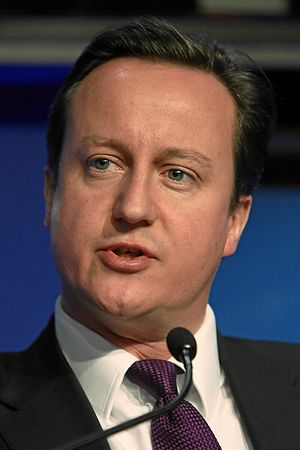
David Cameron, Prime Minister & Leader of the Conservative Party, United Kingdom: Radical Leader of the New Right or podgy faced old buffer and obstacle to reform? (Photo credit: Wikipedia)
Warsaw: Friday 26th October 2012
The Spectator confirms the Death of Toryism:
The Leading Article of The Spectator Magazine, published 13th October, 2012, (http://www.spectator.co.uk/the-week/leading-article/8668591/fringe-benefits/) was an intentionally puzzling affair, gushing and optimistic at the prospect of a youthful, energetic Political Party on the march following a successful conference but oddly despairing at the sluggishness and lack of imagination of the Party’s current leadership. The political party on Question is the British Conservative & Unionist Party, and the reason for the triumphant optimism was that The Spectator is a magazine aimed at the Conservative Party’s intellectual leadership and because it believes it has just witnessed an intellectual awakening at the Party’s Annual Conference.
The Spectator contrasted this with the Labour Party Conference at which it detected little fresh ideas or thinking from the grass-roots. The implication is clear. In ideological terms, at least for the moment, the British Political Right is unabashed, bright, brimming with ideas and vigorously debating the implications implementation of them. Socialism, or at least its leading British political manifestation, in stark contrast, is a spent force intellectually, lacking clear ideological underpinning or radical dynamism.
However the editorial message was not without concern and carried a bleak warning for Conservatives. The radicalism and dynamism shown by the Party’s grass roots is being stifled by a leadership who are proceeding too cautiously and potentially leaving the door open for a Labour Party victory in 2015. Thus the article concluded on a sombre note, suggesting that the answers to Prime Minister, David Cameron’s problems are to be found, both in the cautious approach he has pursued as a coalition Prime Minister since 2010 and in the apparent radicalism and impatience of the brash young party he represents. His task, the leader writer suggests, is to harness the radical and throw out the cautious. As The Spectator clearly believes that Cameron has work to do in this respect, it is safe to say that the intentional sub-text of this, is that he has yet to prove himself capable of rising to this challenge.
Yet, reading this article, I was struck by something else puzzling about it, something which I do not believe The Spectator intended, speaking as it is to a knowing readership who are not outside the political fray, as I am.
For here I was, reading the Editorial Column of a staunchly conservative publication, decrying the conservatism of a leader barely two years into his term as Prime Minister and suggesting to fellow conservatives that the answer to this conservative approach is to be more radical.
The irony here is clear for all to see but ran far deeper than this. For the leader writer was not merely talking of a short-sharp-shock to the system. That I could understand from a Conservative. Rather, The Spectator was calling for the embrace of a fresh new ideological approach from the party whose founding principles are steeped in opposition to ideology of all kinds.
Take its opening sentence;
“The Tory party conference this year was a remarkable success, a festival of conservatism with an impressive array of radical ideas on display.”
Now it is unfair to subject this whole article to detailed textual analysis (Not to mention, unappealing for readers), but this sentence deserves some attention for the multiple layers of contradictory language which appears to be partly the result of political shorthand, and which may have been either intended or accidental.
First and most obviously, there is a direct dichotomy at the heart of this sentence. Is The Spectator really suggesting that a successful ‘festival of conservatism’ would feature an array of radical ideas?
Apparently yes.
The Modern Conservative Party in Britain, it appears, indeed, perhaps the modern Conservative Movement in general, across the globe, is then based on a misnomer. Conservatism with a small ‘c’ (as the Spectator deploys it), is not conservative at all. It is radical and the distinguishing factor making this conference a success was its very radicalism. Had the conference instead been a festival of conservatism, with an array of ideas designed to consolidate, and conserve, we are invited to assume that the conference would have been judged an abject failure, as indeed, the Spectator judges the Labour conference, a week previously.
Yet there is more to this than merely an apparent abandonment of the fundament of conservatism’s stated meaning and intent. For The Spectator uses the term ‘Tory,’ not ‘Conservative.’
A lazy shorthand, I hear you cry!! We all know what he meant. Don’t be such a pedant.
Except, when the term, ‘Tory’ is used as an article of lazy catch-all shorthand, it is usually by Conservatism’s opponents, and designed to carry a critical edge. This dismissive and arguably offensive use of the term irks many Conservatives to this day. Therefore, when a publication rooted in Conservative ideology and history uses the term in the opening line of a gushing article about a vibrant radical conservatism, we can reasonably ask whether this was used, as least in some senses, deliberately.
Just as the use of the ‘N’ word to describe black people is invested with a political meaning far beyond its original intent, as a dismissive insult, so Conservatives have tended to use the word advisedly and to carry specific meaning within what they perceive to be Conservatism generally. Moreover, this has entered common political currency as a distinct subset of Conservative thought generally and done so, some time ago. Take the following description from the 5th Edition of the book, Political Ideologies: An Introduction, (Andrew Heywood, Palgrave Macmillan; 1992[2012], Pg 82), taken from Chapter 3; Conservatism,
‘Key Concept: Toryism: ‘Tory’ was first used in the eighteenth-century to refer to a parliamentary faction that (as opposed to the Whigs) supported monarchical power and the Church of England, and represented the Landed gentry; in the USA, it implied loyalty to the British crown. Although in the nineteenth-century the British Conservative Party emerged out of the Tories, and in the UK ‘Tory’ is still widely (but unhelpfully) used as a synonym for Conservative, Toryism can best be understood as a distinctive ideological stance within broader conservatism. Its characteristic features are a belief in hierarchy, tradition, duty and organicism. While ‘high’ Toryism articulates a neo-feudal belief in a ruling class and a pre-democratic faith in established institutions, the Tory tradition is also hospitable to welfarist and reformist ideas, providing these serve the cause of social continuity.’ (Political Ideologies: An Introduction, Edn 5, Heywood, Pg82)
In other words, while the article probably intends the use of the word, Tory, as a shorthand, it is unlikely to have been an accidental or sloppy usage. The Spectator, will clearly understand the place of old Fashioned Patrician Tory’s such as Harold Macmillan, in the context of their party, and be quite capable of contrasting this stance with the ‘radical’ element of the Party, whose adherents now form the vibrant grass-roots referred to in the sentence. The Spectator is well aware that Patrician Tories were frequently appalled by the new faction which began invading their Party in the wake of the ‘Thatcher Revolution’ from about 1980, and will be quite aware of the description used by Macmillan to describe her policies of privatisation, as “Selling off the family silver.”
So when The Spectator uses the term, ‘Tory‘ in this way, it is doing something quite specific; pronouncing the battle between these factions over; announcing the defeat and death of the Patrician Tory, with his interest in preservation of what the nation has and conserving it for future generations.
The party which once disdained ideology as being essentially inorganic and likely to make things worse, is now radically and progressively forward thinking. One might be tempted to say, less a 21st Century Conservative Party, than a 19th Century Liberal Party, albeit, with a fraction of that institutions broad bottomed diversity of views.
Radical Implications:
Now don’t get me wrong, this is not really news. People of the right have been reminding us for years how, the intellectual vibrancy of their movement contrasts starkly with the ideological brevity of modern left-wing thinking. Moreover, the Emergence of the American ‘Tea Party Movement’ has alerted conservative strategists to the potential groundswell of radical right-wing thinking that can be tapped if parties deploy the right messages, stir up the correct prejudices and fears. Even that is not new. Former Conservative Party leader, William Hague frequently spoke of the fundamental conservatism of working class northerners.
Whether intended or not, this forms a second and very important dichotomy at the heart of the sentence preposition. The Tory Party is no longer in the hands of the old-fashioned Patrician Tories. They are no longer conservative with a small ‘c’ willing only to conserve and consolidate the wealth of the nation or remind us of our duty towards it. That party has now gone to the grave. The ‘Blue Rinse brigade’ now populate the high-end homes for the elderly or the graveyards of Berkshire and Kent.
And I am not suddenly waking up from a coma to realise that the demographics of Conservative conferences in the early 1990’s have radically altered.
But what is interesting here is the offhand way in which this dual phenomenon is proclaimed by The Spectator. The process is deemed to be complete. The Patrician Tories have been vanquished by the ‘New Right.’ Even their name is no longer theirs to hold. It is little more than an appendage to be banded about by the bright young radicals, like the latest designer headgear. The party which once stood for duty, loyalty, tradition and hierarchy now embodies the Liberal ideology of atomised individualism, choice, freedom and personal (that is, individual) accountability. The Party whose intellectual lead came most forcefully from Thomas Hobbes, Leviathan, now more closely resembles John Locke’s small government and Classical Liberalism.
And the first implication of this total victory, is clear. It makes Conservative politics younger and in doing so, makes its leadership look older. Cameron, only two years into his term is painted as an old buffer; a bulwark against radical and dynamic change, when just 24 months ago he himself was the fresh, if podgy, face of the New Right. The first implication is therefore a warning the current leadership. Cameron, Osborne, Hague, perhaps even, Boris Johnson, beware. Your coats are on shoogley pegs, if the Young Turks do not get their way. Two years are a long time in Government.
Okay, that might be overstated. Doubtless the Conservative leadership, while itself, hardly grizzled veterans of government, just two years into the job, still have a few tricks up their sleeve that the Liz Truss’s of this world will need to learn. The article even spells this out. She has been promoted, her radical instincts no longer free to infect the ranks. Her energies are now to be trained on the complex and litigious work of policymaking, rather than the much more intellectually rewarding work of dreaming up policy ideas themselves. Implementation is less glamorous than creation, the political equivalent of child rearing after the blood and thunder and passion of conception and creation are spent. Even the fiery libido’s of Young Turk’s mellow with age.
But the second implication is far more radical.
For if the Conservative Party is to embrace an Ideological approach to politics it is effectively abandoning its single reason for existing since the glorious revolution. Conservatives, both of the large and small ‘C’ verity, are what they are because they implicitly distrust ideology as being too fallible, too much a creation of mankind’s imperfect understanding of the forces of the world, to really improve upon it. It is for this reason that ideologically driven movements such as the 19th Century Liberal Party or the 20th Century Socialist movement, tend to have younger, fierier demographic bases than their Conservative opponents. Radicals, doubtless all want different things, but what they all have in common is a desire to free us from the tyranny of what we have now. The single opponent of all radicals since Oedipus, has been Paternalism.
It is this desire to destroy, tear down and remake, that dictates the need for conservatism in a society. If it did not exist, some radical would have to invent it to prevent us embarking upon some variant of the Chinese Cultural Revolution, whose stated aim was continuous revolution.
I am not a Conservative, politically. I am not especially politically aligned to any party, but, there is a need for a genuinely conservative voice in politics, a voice which puts its metaphorical arm on your metaphorical shoulder and councils, “Hold on, young feller. I’ve been where you are. This is how it ends.”
It is in countering that voice that the radical tests the merits of his reform and learns to apply it with diligence and dexterity. If the voice of conservatism is dead, replaced by a radical free market voice, what is there left to oppose badly conceived reform?
Who will say, “Hold on, this has been tried before. It was called 19th Century laissez-faire Liberalism and came with both good and bad elements. It was not the cure to all of society’s ills. It led to the Irish Potato famine, and indirectly to the current imperfect partition of Ireland. It led to massive income inequality, child labour, and in consequence bread working-class dissatisfaction and the rise of the Trade’s Union movement and the Labour Party to represent them. In freeing the top earners from statutory responsibility, it led some groups of the Wealthy such as the Rowntree’s and Cadbury’s to begin to radically question the value of a society which could treat its poor so callously, and to develop models which would alter and inform the thinking of the Liberal and Labour Movements to this day. Oh yes. And it split the 19th Century Liberal Party asunder. Is that really what you want?”
Hold on, Young Turks. Pay heed to the lessons of the past. Conservatism is not designed to prevent you indefinitely, from applying your remedies. Conservatism is designed to make you stop and think twice. Or rather Toryism is designed to do this. Other forms of conservatism are less malleable, reasonable, constitutional.
A Pause for Reflection
Yet, in stopping, in examining that article again for a moment, might there be cause for optimism as well as fear? Might that optimism fall at the door of the Labour Party, whose own conference was apparently such a festival of the tried and the tested, consolidation, more of the same, the same old same old? If the old ideologies of Marx and Engels, Gramsci & Mercuse are so dated and if nothing has been found to replace them, is that not, by definition, an embrace of un-ideological conservatism?
Might Ed Miliband’s embrace of the term “One nation,” synonymous with 19th Century Conservative leader, Disraeli’s fear of separate parallel nations of rich and poor developing, give us hope that a genuinely conservative voice is once again on the march, seeking to roll back the tide of reform and radicalism, and conserve our precious, our fundamental institutions, The BBC, NHS and Civil Liberties, a living wage? Might the genuine voice of the establishment, the real voice of conservative Britain, be alive and well, after all? In an unexpected place, certainly, but sweet things are often found in unexpected rappers.
Might the future Labour Party conferences come to be dominated by Union Jack’s and the sound of dentures gnashing Blackpool Rock, the toffee sucking ‘Ginger Rinse Brigade,” row upon row of Barbara Castle look-a-likes, indulging in Land of Hope and Glory and the Red Flag, a time-honoured tradition, hated by the radicals in the New Right Tories.
Might they yet be Britain’s last line of defence against the sweeping tide of radicalism threatening to trigger revolt across the civilised world?
Cast yourself forward to the future. See the sights and sounds of a Labour Party Conference commencing, its time-honoured traditions, echo’s of bygone eras. There is the annual sight of the elderly Blair and Brown sitting next to one another, but still not speaking, after all these years. There is the traditional five-minute standing ovation for the party leader, borrowed from the dictatorship of Thatcher rather than that of Stalin. There is the annual wheeling out of the one remaining celebrity willing to stand by this old political war-horse, as an elderly Ben Elton, is wheeled out to give his time-honoured take on the New Right.
But this is still day one. These treats have yet to be had.
For now all is expectation. Stalls are being set up outside the conference hall. A smattering of bleary eyed party officials are making last-minute changes to the debate schedule. The Moderator stands to declare proceedings underway to a still near empty conference floor; “Conference, Comrades, the National Executive Committee hereby advises the commencement of Agenda item 1a, that the plebiscite debate: 1, composite: B, subset: A, ‘Conference proposes party name change to The Labour, Conservative & Unionist Party,’ is now in session…”
Stranger things have happened under the Sun…

